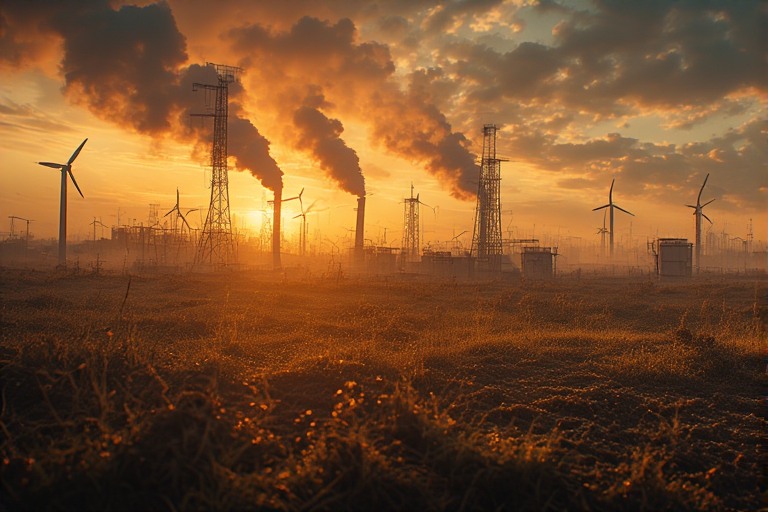
The Energy Transition as Imperial Battleground (2026)
Green Industrial Policy, Resource Imperialism, and the Limits of Techno-Fix
The climate imperative has been assimilated into imperial strategy with remarkable speed. What began as recognition of ecological limits—scientific consensus on warming, destabilized weather patterns, accelerating biodiversity loss—has been transformed into the next great project of capitalist restoration. The "energy transition," "green new deal," "net zero"—these formulations promise simultaneous resolution of environmental crisis and economic stagnation, technological modernization and social cohesion, competitive positioning and planetary responsibility. The promise is familiar: investment flows, job creation, restored industrial vigor, maintained or enhanced geopolitical advantage. The structure of justification mirrors the AI hype cycle analyzed previously—narrative momentum substituting for demonstrated transformation, speculative projection masking material constraint.
The purpose here is not to dismiss energy transition as unnecessary or impossible. The fossil economy must be dismantled; the atmospheric carbon budget is approaching exhaustion; the consequences of inaction include civilizational collapse. The question is whether the transition as presently constituted—through market mechanisms, corporate investment, and state subsidy within existing property relations—can achieve its stated objectives, and whose interests it serves when it fails. The historical record of capitalist environmental management suggests caution: technological substitution without consumption reduction, displacement of costs onto peripheral populations, greenwashing of continued extraction, and the systematic prioritization of profit over sustainability.
The American empire in 2026 approaches energy transition with distinctive constraints and opportunities. Its domestic fossil production—unconventional oil and gas—has achieved nominal "energy independence" while locking in carbon-intensive infrastructure for decades. Its manufacturing base, eroded through financialization and offshore relocation, lacks the capacity for rapid renewable equipment deployment. Its political system, captured by fossil interests and ideological hostility to state intervention, impedes the coordinated planning that transition requires. Into this gap, "green industrial policy" has been inserted as compensatory promise: the Inflation Reduction Act, the CHIPS Act, the infrastructure bill—massive public expenditure to restore productive capacity under environmental cover.
Whether this insertion can overcome structural obstacles, represents genuine transformation or subsidy capture, and can proceed fast enough to meet carbon budgets while maintaining competitive position against Chinese industrialization—these questions determine the transition's geopolitical significance. The assessment here is skeptical: the scale of transformation required exceeds what financialized capitalism can deliver, the timeline of climate physics is shorter than what political and institutional reconstruction permits, and the competitive dynamics of interstate rivalry distort transition toward militarization and extraction rather than sustainability and equity. This is not a bug but a feature: the transition is being designed as a new regime of accumulation, creating fresh avenues for profit and geopolitical control where the old fossil regime is decaying.
The Material Base: Minerals, Infrastructure, and Geopolitical Competition
Renewable energy systems—solar, wind, batteries, grids—require material inputs in quantities that dwarf fossil infrastructure. Copper for electrification; lithium, cobalt, nickel for batteries; rare earth elements for magnets and electronics; polysilicon for solar panels; steel and cement for construction. The International Energy Agency projects that achieving net zero by 2050 requires a fourfold increase in mineral extraction by 2040, with some commodities—lithium, graphite, nickel—growing fortyfold. This is not substitution but expansion: new extractive frontiers, new environmental destruction, new colonial relationships.
The geographic concentration of these resources reproduces patterns familiar from oil and gas. Lithium extraction concentrates in the "lithium triangle" of Chile, Argentina, and Bolivia; cobalt in the Democratic Republic of Congo; rare earth processing in China; nickel in Indonesia and the Philippines. The purported energy transition thus reconstitutes resource dependency rather than eliminating it, shifting vulnerability from hydrocarbon flows to mineral supply chains. The imperial powers that controlled oil concessions now compete for mining rights, offtake agreements, and processing capacity.
The American response combines domestic subsidy with external pressure. The Inflation Reduction Act conditions tax credits on North American content or free-trade partner origin, explicitly constructing supply chains independent of Chinese control. The Minerals Security Partnership—administered by the State Department—coordinates investment in extraction and processing across allied countries. The Development Finance Corporation provides capital for projects in Africa, Latin America, and Asia that meet strategic criteria. The structure resembles earlier resource imperialism: public risk assumption for private profit extraction, with environmental and labor standards externalized onto host populations.
Chinese industrial policy has achieved earlier and more comprehensive positioning. Domestic rare earth mining and processing, developed over decades, supplies most global demand. Battery manufacturing capacity exceeds combined Western output. Solar panel production dominates world markets. The "new three"—solar, batteries, electric vehicles—have become export engines comparable to earlier textile and electronics manufacturing. American policy responds through containment: tariffs, sanctions, investment restrictions, and the attempted construction of parallel supply chains that increase costs and delay deployment.
The competitive dynamic distorts transition toward militarization. Critical minerals are designated "strategic" justifying stockpiling, price controls, and eventual military protection of supply routes. The environmental framing legitimizes extraction that would otherwise face opposition. The timeline of climate physics—rapid emissions reduction—conflicts with the timeline of supply chain construction—decades for mine development, processing capacity, manufacturing scale. The result is continued fossil dependency during transition construction, with carbon budgets exhausted before renewable systems achieve dominance.
The Infrastructure Gap: Grids, Storage, and System Integration
Renewable electricity generation—solar and wind—is intermittent and geographically dispersed. Utilization requires transformed grids: expanded transmission to connect resource-rich regions with consumption centers, distribution upgrades for bidirectional flow, demand management systems, and massive storage for temporal mismatch. The infrastructure investment required exceeds generation capacity costs and encounters political obstacles that generation does not.
American grid infrastructure is antiquated, balkanized, and institutionally fragmented. Three separate interconnections—East, West, Texas—with limited capacity between them. State regulatory authority over utilities prevents national coordination. Local opposition to transmission siting—"not in my backyard" extended across jurisdictions—blocks necessary construction. The infrastructure bill appropriates funds for grid modernization, but timelines extend across electoral cycles that may terminate commitment. The scale of investment required—trillions of dollars, decades of construction—conflicts with the quarterly return expectations of financialized ownership.
Storage technologies—batteries, pumped hydro, hydrogen, emerging alternatives—remain inadequate for seasonal variation and multi-day calm periods. Lithium-ion batteries, dominant for vehicles and short-duration storage, face material constraints and degradation limits. Long-duration storage—pumped hydro, compressed air, hydrogen—requires specific geography or suffers efficiency losses that compromise economic viability. The "100% renewable" scenarios that dominate policy discourse assume storage solutions that do not presently exist at required scale and cost.
The Chinese grid system, state-owned and centrally planned, has achieved more rapid integration. Ultra-high-voltage transmission lines connect western renewable resources with eastern consumption centers. Massive pumped hydro construction provides storage capacity. The institutional capacity for coordinated infrastructure investment that Western financialized systems lack enables faster transition deployment. Whether this represents model or exception—whether Chinese state capacity can be replicated in different political conditions, whether it can overcome its own constraints of debt, demography, and ecological degradation—remains uncertain.
Green Industrial Policy: Subsidy, Capture, and Contradiction
The Inflation Reduction Act—$369 billion in climate and energy appropriations—represents the largest American industrial policy intervention since World War II. Its structure reveals the constraints on transformation within existing political economy. Tax credits rather than direct public investment preserve private ownership and profit extraction. Domestic content requirements increase costs and delay deployment. Technology-neutral mechanisms subsidize incumbent technologies—carbon capture, hydrogen from natural gas—alongside genuine renewables. The fossil fuel industry, through lobbying and political capture, extracts concessions that prolong its existence: lease requirements, carbon capture subsidies, hydrogen production from fractured gas.
The employment effects are uncertain and geographically concentrated. Manufacturing jobs in solar panel and battery factories, construction jobs in installation and grid expansion, but limited employment in ongoing operation. The "just transition" for fossil fuel workers—promised retraining and relocation—remains largely unrealized. The geographic concentration of renewable resources—sunbelt solar, plains wind—contrasts with fossil fuel employment in Appalachia, the Gulf Coast, the Mountain West, generating political opposition from regions left behind.
The competitive dynamic with China generates further contradictions. Tariffs on Chinese solar panels and batteries increase deployment costs, slowing transition. Domestic content requirements delay projects that cannot source compliant equipment. The attempted construction of parallel supply chains—"friend-shoring"—expands to include countries with lower labor and environmental standards, reproducing the outsourcing that eroded American manufacturing. The environmental framing legitimizes trade war and industrial policy that would otherwise face ideological opposition from market fundamentalism.
The European variant—the Green Deal, REPowerEU—exhibits comparable tensions. Energy price spikes following the Ukraine war accelerated renewable deployment but also revived coal and lignite generation. Industrial competitiveness concerns—energy costs higher than American or Chinese competitors—generate demands for subsidy and protection that strain EU coherence. The "strategic autonomy" framing justifies state intervention that market orthodoxy previously prohibited, but the intervention remains constrained by fiscal rules and competitive dynamics that favor incumbent corporate interests.
The Financialization of Transition: Green Bonds and Short-Term Logic
Before examining the extractive dimension, the funding mechanisms deserve attention. The transition is being financed through instruments that replicate the pathologies of financialized capitalism. Green bonds, ESG funds, carbon credits, and speculative venture capital are structurally oriented toward short-term returns and asset inflation, not long-term system resilience or ecological restoration. The logic of shareholder value maximization conflicts with the patient, high-risk capital deployment that infrastructure construction and technological innovation require.
This creates a fundamental tension: the transition requires planning horizons of decades, while its funding depends on markets that evaluate performance in quarters. The result is investment concentration in "bankable" projects with quick returns—utility-scale solar farms, electric vehicle charging networks—while essential but unprofitable components receive inadequate attention. The financial architecture of the transition thus builds in the same myopia that created the climate crisis, with Wall Street firms developing derivatives and securitization products around green assets that create new vectors of systemic risk.
The Inflation Reduction Act, while channeling public funds, relies heavily on tax credits that must be monetized through private financial intermediaries. This ensures that significant public subsidy becomes financial sector profit through complex structuring and fee extraction. The transition becomes another arena for financial engineering, with the same institutions that precipitated the 2008 crisis now positioned to profit from the response to climate crisis.
The Extractive Return: Colonial Patterns in Green Transition
The mineral requirements of energy transition reconstitute colonial extraction under environmental cover. Lithium extraction in Chile's Atacama Desert consumes water in the world's driest region, contaminating indigenous communities and destroying ecosystems. Cobalt mining in the Democratic Republic of Congo employs child labor in dangerous conditions, with artisanal miners selling to traders who supply Chinese processing facilities. Nickel mining in Indonesia deforests rainforest and generates toxic waste. The "clean energy" consumed in Western cities requires dirty extraction at the periphery, with environmental and social costs externalized onto populations excluded from transition benefits. The battery that powers an electric vehicle in Berlin or Boston is, in this sense, a condensed product of colonial relations, its purported cleanliness predicated on distant sacrifice zones.
The governance mechanisms for managing this extraction remain inadequate. Corporate social responsibility initiatives and voluntary standards fail to prevent abuse. Host country governments, dependent on export revenue and investment, prioritize extraction over environmental protection and labor rights. International financial institutions provide capital for projects that meet formal criteria while generating systematic harm. The "critical minerals" framing—strategic necessity, supply security—legitimizes extraction that would otherwise face opposition, subordinating environmental and social concerns to competitive positioning.
The resistance to this extraction is growing but fragmented. Indigenous communities in extraction zones organize against displacement and contamination. Environmental movements in consuming countries oppose mining in their own territories while struggling with complicity in overseas extraction. Labor movements in processing industries demand decent conditions and living wages. The coordination of this resistance across supply chains—connecting Congolese miners, Chilean indigenous communities, European environmentalists, American consumers—remains nascent, impeded by geographic distance, informational asymmetry, and the ideological power of "clean energy" framing.
The alternative—genuine sustainability through consumption reduction, circular economy, extended product life, public transit, and localized production—conflicts with the growth imperative that structures capitalist transition. The "degrowth" perspective—articulated by ecological economists and social movements—remains marginal to policy discourse, dismissed as politically impossible despite its scientific necessity. The transition as constituted prioritizes continued expansion—of energy supply, material throughput, economic output—through technological substitution rather than social transformation.
Climate Physics and Political Time
The carbon budget for limiting warming to 1.5°C—if such limitation remains possible—requires global emissions reduction of approximately 50% by 2030 and net zero by 2050. The current trajectory, even with optimistic assumptions about transition deployment, exceeds this budget. The gap between required and projected emissions grows with each year of delay. The "net" in net zero—carbon capture, offset markets, future technological removal—functions as accounting fiction that permits continued fossil combustion.
The political time of democratic capitalism—electoral cycles, quarterly returns, budget appropriations—conflicts with the geological time of climate physics. Infrastructure construction requires decades; carbon budgets expire in years. The institutional capacity for long-term planning and sustained commitment that transition requires has been eroded by neoliberal restructuring. The competitive dynamics of interstate rivalry prioritize short-term positioning over collective survival. Furthermore, the massive new infrastructure demanded by this transition—mines, processing plants, gigafactories, grids—creates a "green lock-in," a decades-long material commitment to a specific, high-throughput industrial model that may itself become an obstacle to more adaptive, low-consumption futures.
The American political system, with its veto points, polarization, and capture by fossil interests, appears particularly incapable of rapid transformation. The Inflation Reduction Act, passed on partisan lines, faces repeal threats with each electoral alternation. State-level variation—California's acceleration versus Texas's obstruction—generates incoherence that national coordination cannot resolve. The judicial system, increasingly hostile to regulatory action, constrains executive capacity that legislation does not.
The Chinese system, with its state capacity for long-term planning and insulation from electoral pressure, has achieved more rapid renewable deployment. Yet its emissions continue growing—coal consumption increased in 2022-2023—because industrial growth outpaces clean energy addition. The "carbon peak by 2030, net zero by 2060" commitment, while ambitious, exceeds the timeline that global carbon budgets permit. The competitive dynamic with the United States—military expenditure, technological rivalry, resource competition—distorts investment priorities and accelerates fossil infrastructure in both systems, making China the world's largest driver of both renewable deployment and new coal power.
The Military Dimension: Green War and Climate Security
The climate-security nexus has been assimilated into military doctrine with disturbing speed. The Pentagon identifies climate change as "threat multiplier"—generating instability, migration, resource competition that requires military response. The framing legitimizes continued military expenditure, base expansion, and intervention capacity under environmental cover. The military's own emissions—largest institutional emitter in the United States—remain exempt from climate accounting and transition requirements.
The "greening" of military operations—solar panels on bases, biofuels for vehicles, efficiency improvements—functions as public relations without addressing fundamental contribution to warming. The weapons systems, supply chains, and global infrastructure of American military power remain carbon-intensive. The strategic competition with China—naval expansion, base construction, weapons modernization—consumes resources that transition requires.
The Arctic emerges as particular zone of militarized climate impact. Ice retreat opens shipping routes and resource extraction opportunities that generate territorial competition. American, Russian, Chinese, and NATO military posture intensifies in a region experiencing warming four times global average. The "security" framing—protecting critical infrastructure, responding to search and rescue needs—legitimizes military expansion that accelerates the warming it claims to manage.
This militarization extends to critical resource zones. The "Lithium Triangle" in South America sees increased activity from U.S. Southern Command and competitive Chinese Belt and Road investments, framing resource security as national security issue. The resource competition generated by transition thus extends rather than reduces the military footprint of imperial powers, reconstituting geopolitical rivalry around new resource dependencies. Critical mineral supply chains require protection; sea lanes for battery component transport must be secured; extraction sites in unstable regions demand military presence. The environmental transition creates its own security demands that justify expanded imperial projection.
Conclusion: Transition Without Transformation
The energy transition as presently constituted cannot achieve its stated objectives. The scale of transformation required—rapid emissions reduction, infrastructure reconstruction, consumption reorganization—exceeds what financialized capitalism can deliver within climate timelines. The competitive dynamics of interstate rivalry distort transition toward extraction, militarization, and continued fossil dependency. The growth imperative that structures capitalist development conflicts with the consumption reduction that sustainability requires.
The American empire's attempt at green industrial policy—massive subsidy, protectionist construction, competitive containment of China—represents recognition of these constraints without transcendence of them. The Inflation Reduction Act and associated measures may achieve partial industrial restoration and accelerated renewable deployment without approaching carbon budget compliance or genuine sustainability. The "jobs versus environment" framing that structured earlier environmental politics is superseded by "jobs through environment"—green capitalism as restoration promise—but the restoration remains partial and the sustainability illusory.
The Chinese alternative—state-led industrialization, rapid renewable deployment, continued growth—achieves faster transition metrics without resolving the fundamental contradiction between expansion and limits. The "ecological civilization" framing—official Party doctrine—coexists with coal plant construction, carbon-intensive infrastructure investment, and global resource extraction that externalizes environmental costs. Whether Chinese state capacity can eventually reconcile growth with sustainability, or whether it encounters hard limits that systemic transition cannot overcome, remains the great experiment of our period.
For the peripheral populations—Congolese cobalt miners, Chilean lithium extractors, Indonesian nickel workers, Pacific islanders facing sea level rise—the transition as constituted offers continuation of exploitation without compensation for climate damage caused by others' consumption. The "common but differentiated responsibilities" framework of climate negotiations—historical emitters bear greater obligation—is systematically violated by continued extraction, insufficient finance, and technology withholding. The climate debt remains unpaid; the ecological debt accumulates.
The alternative—genuine transition through consumption reduction, public ownership of energy systems, democratic planning of production, international solidarity rather than competitive rivalry—requires political transformation that existing structures prevent. The immediate struggle includes concrete demands: a Global Just Transition Treaty that mandates technology transfer, debt cancellation, and shared intellectual property for green technology, funded by redirecting fossil fuel subsidies and military expenditure. More fundamentally, it requires connecting resistance across supply chains and national boundaries to prevent the environmental framing from legitimizing continued extraction and militarization, and to demand that transition benefits flow to workers and communities rather than corporations. Whether this struggle can achieve scale and coordination before carbon budgets exhaust and tipping points trigger, whether the gap between climate physics and political possibility can be closed through mobilization rather than catastrophe—these questions determine whether the energy transition becomes the next chapter of imperial decline or the opening of genuine transformation. The battle is no longer between transition and stagnation, but between a transition that replicates empire and a transformation that transcends its logic.
By Lisa Anderson
References
Organized by Analytical Themes
The Assimilation of Climate into Imperial Strategy
Claim: The climate imperative has been transformed from ecological recognition into a project of capitalist restoration and competitive positioning.
Naomi Klein — Examines how crisis narratives enable corporate restructuring and the "shock doctrine" of privatization. See This Changes Everything: Capitalism vs. the Climate (2014) and The Shock Doctrine: The Rise of Disaster Capitalism (2007).
Christian Parenti — Analyzes the "politics of the armed lifeboat" and the militarization of climate response. See Tropic of Chaos: Climate Change and the New Geography of Violence (2011).
Andreas Malm — Critiques "green capitalism" and the impossibility of ecological sustainability within capitalist growth imperatives. See Fossil Capital: The Rise of Steam Power and the Roots of Global Warming (2016) and How to Blow Up a Pipeline (2021).
John Bellamy Foster, Brett Clark, and Richard York — Develop the "metabolic rift" framework for analyzing ecological crisis under capitalism. See The Ecological Rift: Capitalism's War on the Earth (2010).
Critical Minerals and Resource Imperialism
Claim: The energy transition reconstitutes resource dependency through intensified mineral extraction with colonial patterns.
Thea Riofrancos — Analyzes the "extractive imperative" in Ecuador and the political economy of resource nationalism. See Resource Radicals: From Petro-Nationalism to Post-Extractivism in Ecuador (2020).
Siddharth Kara — Documents cobalt mining conditions in the Democratic Republic of Congo. See Cobalt Red: How the Blood of the Congo Powers Our Lives (2023).
Giuliano Martiniello — Examines agrarian change and extractive capitalism in Africa. See work on "new scramble for Africa" and green extractivism.
International Energy Agency (IEA) — Provides data on mineral requirements for energy transition. See The Role of Critical Minerals in Clean Energy Transitions (2021) and subsequent reports.
Michael Hudson — Analyzes the historical patterns of resource imperialism and debt-structured extraction. See Super Imperialism: The Economic Strategy of American Empire (1972, updated 2003) and Global Fracture: The New International Economic Order (1977, updated 2005).
Infrastructure, Grid Modernization, and State Capacity
Claim: Renewable integration requires transformed infrastructure that financialized and fragmented systems cannot deliver.
Matthew T. Huber — Examines the political economy of electrification and the possibilities for public power. See Lifeblood: Oil, Freedom, and the Forces of Capital (2013) and Climate Change as Class War: Building Socialism on a Warming Planet (2022).
Timothy Mitchell — Analyzes the political consequences of energy systems and "carbon democracy." See Carbon Democracy: Political Power in the Age of Oil (2011).
Gretchen Bakke — Documents the fragility of American grid infrastructure. See The Grid: The Fraying Wires Between Americans and Our Energy Future (2016).
Mariana Mazzucato — Examines state capacity for mission-oriented investment and the entrepreneurial state. See The Entrepreneurial State: Debunking Public vs. Private Sector Myths (2013) and Mission Economy: A Moonshot Guide to Changing Capitalism (2021).
Green Industrial Policy and Subsidy Capture
Claim: The Inflation Reduction Act and comparable measures reveal constraints on transformation within financialized capitalism.
Robert Pollin — Develops frameworks for green transition and full employment. See Greening the Global Economy (2015) and work at Political Economy Research Institute (PERI).
Daniela Gabor — Analyzes "Wall Street Consensus" and the financialization of development. See "The Wall Street Consensus" (2020) and subsequent work on green finance.
Brett Christophers — Examines rentier capitalism and the political economy of asset ownership. See Rentier Capitalism: Who Owns the Economy, and Who Pays for It? (2020) and The Price is Everything: How Capitalism Came to Colonize the Future (2024).
Michael Hudson — Distinguishes between industrial and finance capitalism, analyzing how debt overhead and rent extraction prevent productive investment. His analysis of tax credits as financialized subsidy mechanisms informs the treatment of IRA structure.
Financialization of Transition
Claim: Green bonds, ESG funds, and market mechanisms replicate short-term logics incompatible with transformation requirements.
Déborah Danowski and Eduardo Viveiros de Castro — Critique the "imminence of the end" and the politics of climate temporality. See The Ends of the World (2016).
Leigh Phillips and Michal Rozworski — Argue for planning and abundance against austerity environmentalism. See The People's Republic of Walmart: How the World's Biggest Corporations are Laying the Foundation for Socialism (2019).
Adrienne Buller — Critiques "green finance" and the contradictions of market-based climate policy. See The Value of a Whale: On the Illusions of Green Capitalism (2022).
Greta Krippner — Documents the political construction of financialization. See Capitalizing on Crisis: The Political Origins of the Rise of Finance (2011).
Extractivism, Colonialism, and Resistance
Claim: The transition externalizes environmental and social costs onto peripheral populations while legitimizing extraction through green framing.
Eduardo Gudynas — Develops the concept of "extractivism" and post-extractivist alternatives. See "Transitions to Post-Extractivism: Directions, Options, Areas of Work" (2013) and subsequent work.
Maristella Svampa — Analyzes "commodities consensus" in Latin America and the limits of progressive extractivism. See Debates Latinoamericanos: Indianismo, Desarrollo, Dependencia y Populismo (2016).
Max Ajl — Examines agrarian questions and ecological politics in the Global South. See A People's Green New Deal (2021).
Vijay Prashad — Documents the "darker nations" and the politics of the Global South. See The Darker Nations: A People's History of the Third World (2007) and The Poorer Nations: A Possible History of the Global South (2012).
Arturo Escobar — Develops "territorial" alternatives to extractive development. See Designs for the Pluriverse: Radical Interdependence, Autonomy, and the Making of Worlds (2017).
Climate Physics, Temporal Contradiction, and Lock-In
Claim: The timeline of infrastructure construction conflicts with carbon budget exhaustion, creating "green lock-in" to unsustainable pathways.
IPCC (Intergovernmental Panel on Climate Change) — Provides scientific basis for carbon budgets and emission trajectories. See Global Warming of 1.5°C (2018) and subsequent assessment reports.
Jason W. Moore — Develops "world-ecology" framework and analyzes capitalism as "cheapening" of nature. See Capitalism in the Web of Life: Ecology and the Accumulation of Capital (2015).
Andreas Malm — Analyzes the temporal contradictions of climate politics and the necessity of "revolutionary" rupture. See Corona, Climate, Chronic Emergency: War Communism in the Twenty-First Century (2020).
Paul Burkett — Marxist ecological analysis of climate and capitalism. See Marx and Nature: A Red and Green Perspective (1999, expanded 2014).
Militarization, Climate Security, and Green War
Claim: The climate-security nexus legitimizes military expansion while exempting military emissions from transition requirements.
Neta C. Crawford — Documents Pentagon energy consumption and military emissions. See The Pentagon, Climate Change, and War: Charting the Rise and Fall of US Military Emissions (2022).
Michael T. Klare — Analyzes resource competition and military rivalry. See All Hell Breaking Loose: The Pentagon's Perspective on Climate Change (2019) and The Race for What's Left: The Global Scramble for the World's Last Resources (2012).
Simon Dalby — Examines the "environmental security" framing and its political consequences. See Security and Environmental Change (2009) and Anthropocene Geopolitics: Globalization, Security, Sustainability (2020).
Joanne Liu and the International Campaign to Abolish Nuclear Weapons (ICAN) — Document the humanitarian consequences of military environmental impact.
Degrowth, Alternatives, and Political Transformation
Claim: Genuine sustainability requires consumption reduction and social transformation that capitalist transition prevents.
Serge Latouche — Develops "degrowth" as project of radical social transformation. See Farewell to Growth (2009) and The Westernization of the World: The Significance, Scope and Limits of the Drive Towards Global Uniformity (1996).
Giorgos Kallis — Analyzes degrowth as concrete policy program. See Degrowth (2018) and Limits: Why Malthus Was Wrong and Why Environmentalists Should Care (2019).
Jason Hickel — Argues for "less is more" and post-growth economics. See Less is More: How Degrowth Will Save the World (2020) and The Divide: A Brief Guide to Global Inequality and Its Solutions (2017).
Erik Olin Wright — Analyzes "real utopias" and transformative institutional change. See Envisioning Real Utopias (2010) and How to Be an Anti-Capitalist in the Twenty-First Century (2019).
Michael Hudson — Documents historical alternatives to debt-peonage capitalism and possibilities for public banking and democratic financial control. See ...and Forgive Them Their Debts: Lending, Foreclosure and Redemption from Bronze Age Finance to the Jubilee Year (2018) and The Destiny of Civilization: Finance Capitalism, Industrial Capitalism or Socialism (2022).
Intellectual Tradition and Overall Framing
The text's overarching framework is most directly informed by:
Immanuel Wallerstein (World-Systems Analysis) — The concepts of hegemonic cycles, core-periphery extraction, and the structural crisis of accumulation. See The Modern World-System (4 vols., 1974-2011).
Giovanni Arrighi — The analysis of systemic cycles of accumulation and the "terminal crisis" of American hegemony. See The Long Twentieth Century: Money, Power, and the Origins of Our Times (1994).
James O'Connor — The "second contradiction of capitalism" between production conditions and profit realization. See Natural Causes: Essays in Ecological Marxism (1998).
Joan Martinez-Alier — The "environmentalism of the poor" and ecological economics. See The Environmentalism of the Poor: A Study of Ecological Conflicts and Valuation (2002).
Michael Hudson — Synthesizes classical political economy, economic history, and contemporary finance to analyze the dynamics of debt, empire, and ecological destruction. His work on the "tribute economy," the distinction between industrial and finance capitalism, and the impossibility of reform within financialized structures provides essential grounding for the text's assessment of green industrial policy as failed compensatory promise. His analysis of infrastructure investment, public banking, and the historical alternatives to debt-peonage informs the treatment of transformative possibilities.
Wolfgang Streeck — The analysis of capitalist decomposition and the exhaustion of institutional stabilization. See How Will Capitalism End? Essays on a Failing System (2016).
Herbert Marcuse — The critique of "one-dimensional" society and the possibilities for its transcendence. See One-Dimensional Man: Studies in the Ideology of Advanced Industrial Society (1964) and Counterrevolution and Revolt (1972).
Want to stay informed about global economic
trends?
Subscribe to our newsletter for weekly analysis and insights
on international politics and economics.